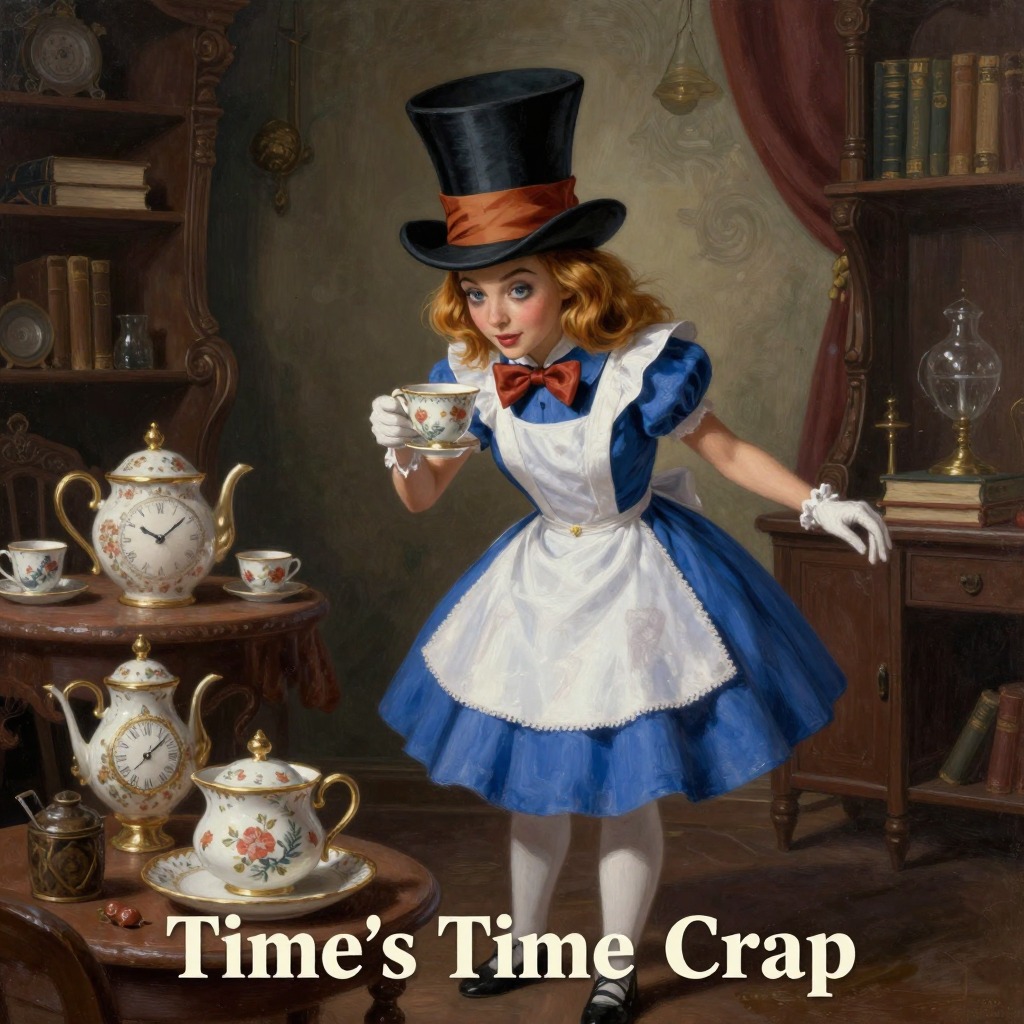
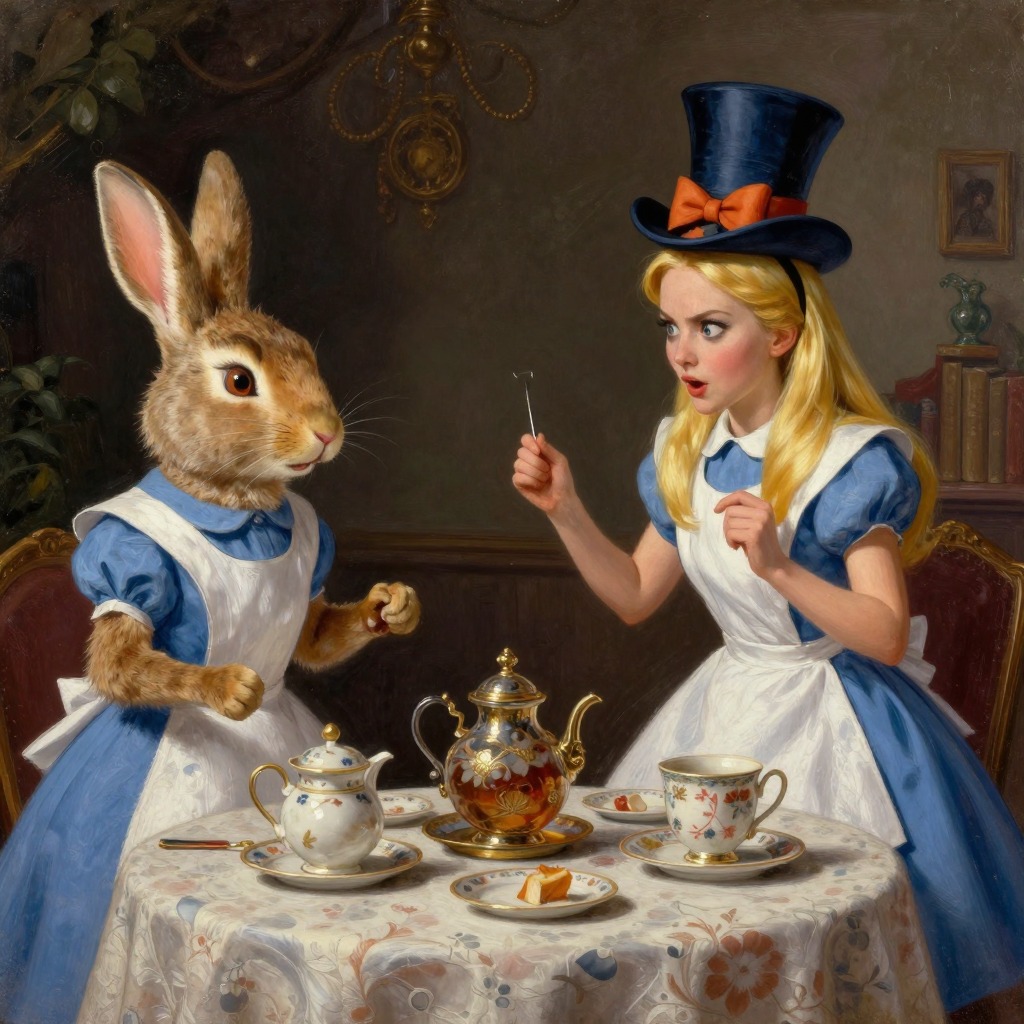
It's always six o'clock now
The rule "it's always six o'clock now" is the governing principle of the Mad Tea-Party, a temporal stasis that traps the Hatter, the March Hare, and the Dormouse in an endless tea-time. The rule originates from a quarrel the Hatter had with Time himself, after an incident at a concert given by the Queen of Hearts. The Hatter explains to Alice that he had been singing "Twinkle, twinkle, little bat!" when the Queen jumped up and shouted, "He's murdering the time! Off with his head!" Since that moment, Time has refused to do anything the Hatter asks, and the clock has been frozen at six o'clock. This means it is perpetually tea-time, and the three companions have no time to wash the tea-things between uses, so they keep moving around the table as the things get used up. When Alice asks what happens when they come to the beginning again, the March Hare interrupts to change the subject, leaving the question unanswered. The rule thus creates a closed, repetitive loop of activity, a ritual without progression or end. It is a direct consequence of the Queen of Hearts' arbitrary and violent authority, and it illustrates how Wonderland's inhabitants are subject to irrational, unchangeable decrees that suspend normal temporal flow. The Hatter's mournful tone as he recounts the story underscores the rule's oppressive nature, yet the tea-party continues mechanically, a perfect emblem of Wonderland's blend of absurdity and rigid, inescapable logic.
Origin and Cause
The rule "it's always six o'clock now" is the direct result of a personal quarrel between the Hatter and Time, which occurred at a great concert given by the Queen of Hearts. The Hatter was singing a song, "Twinkle, twinkle, little bat!" when the Queen jumped up and accused him of "murdering the time," shouting for his execution. Though the Hatter escaped beheading, Time took offense and has since refused to do anything the Hatter asks. The Hatter explains that if one keeps on good terms with Time, he will do almost anything with the clock, such as advancing it to dinner-time on a whim. But after the quarrel, Time became uncooperative, and the clock has been stuck at six o'clock ever since. The March Hare, who was present at the concert and is pointed at by the Hatter as the one who "went mad" just before the quarrel, shares in the punishment. The rule thus originates from a combination of the Queen's tyrannical temper and the Hatter's failed performance, and it is enforced not by any authority but by the immutable will of Time himself.
Consequences and Operation
The rule creates a perpetual tea-time, with no possibility of moving to any other hour. The Hatter, the March Hare, and the Dormouse are therefore condemned to an endless tea-party, where they have no time to wash the dishes between uses. As the Hatter explains, they keep moving around the table as the things get used up, but the cycle never ends. When Alice asks what happens when they come to the beginning again, the March Hare interrupts and changes the subject, suggesting that the loop has no resolution or that the question is itself a violation of the tea-party's logic. The rule also affects the Hatter's watch, which tells the day of the month but not the hour, because the hour is always the same. The Hatter's watch is two days wrong, a malfunction he blames on the March Hare for using the best butter with a bread-knife, but the deeper cause is the frozen time that makes accurate timekeeping irrelevant. The rule thus governs not only the social ritual of the tea-party but also the physical objects associated with it, creating a self-contained system of absurd cause and effect.
Thematic Significance
The rule "it's always six o'clock now" is a key example of Wonderland's inversion of normal temporal logic and its replacement with arbitrary, unchangeable decrees. It illustrates the theme of arrested time, where characters are trapped in a single moment, unable to progress or escape. The rule also reflects the Queen of Hearts' influence, as her violent reaction to the Hatter's song set the chain of events in motion. The tea-party itself becomes a ritual without purpose, a parody of social convention where the participants are bound by a rule that makes no sense but cannot be broken. The Hatter's mournful tone and the March Hare's evasiveness suggest a resigned acceptance of their fate, while Alice's practical questions highlight the absurdity of the situation. The rule thus serves as a microcosm of Wonderland's broader structure, where logic is replaced by arbitrary rules, and time is not a linear progression but a static, repetitive cycle.